


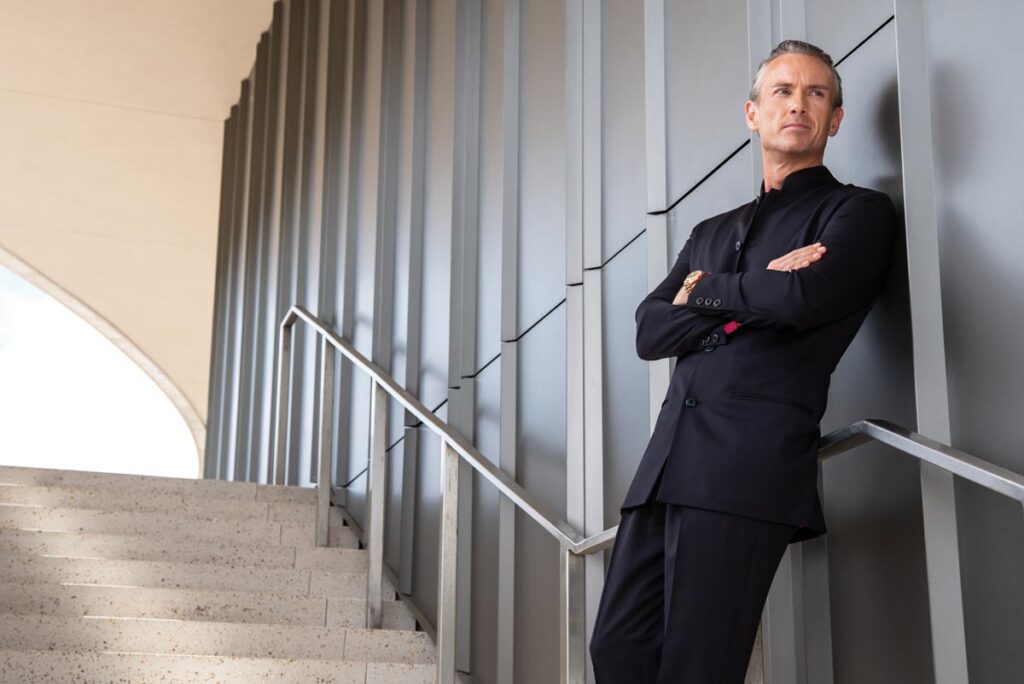
With five grand pianos in his childhood home, Alexander Shelley was surrounded by the sounds of music. Born in London in 1979 to celebrated British pianist Howard Shelley and Irish pianist Hilary Macnamara, Shelley began life hearing his parents interacting and expressing themselves in melodic harmony. As a young child, he learned piano and cello and how to play music by ear. Music was his mother tongue. “It was all I really knew,” says Shelley, whose myriad roles include serving as the Sharon and Timothy Ubben Artistic and Music Director for Artis—Naples.
Many children with his upbringing might feel obliged or expected to choose a similar path to his parents’ careers. Shelley’s parents, however, wanted him to discover his unique passion and purpose in life, so they sought a broader education for their son. They sent him to Westminster School in central London, known for its rigorous academics and intellectual independence, yet still allowing plenty of time for the arts. Shelley discovered he loved all subjects, including sports—anything with a ball and a racket. Today, long-distance running is his exercise of choice to stay fit and sane. “I could not live without movement in my life,” he says.
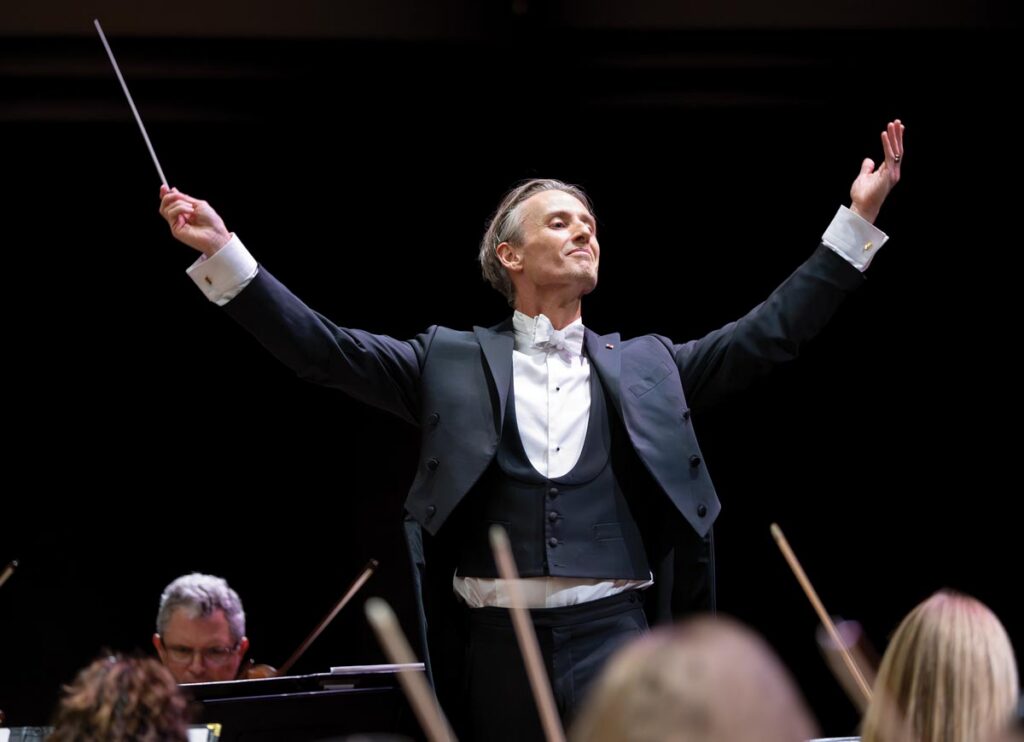
While a student at Westminster, Shelley asked to direct the school orchestra and recalls loving the experience. After attending the Royal College of Music in London, he studied cello and conducting at the Robert Schumann Hochschule in Düsseldorf, Germany. Leading an elite group of musicians through the vast repertoire of classic symphonic literature became his greatest passion in life. “There is no genre of music larger than classical,” he explains. “It spans a vast spectrum—more than 600 years and five continents, and ranges from two-minute études to four-hour operas.”
Shelley loves and plays all kinds of music, including pop and jazz, and listens to it all. A self-described anti-ideologue, he believes that “saying one likes or does not like a particular type of music is selling an experience short.” While studying in Germany, he formed a band with his buddies. They covered songs by artists as diverse as 50 Cent and Britney Spears. When it comes to music genres, he does not discriminate.
Orchestral Maneuvers
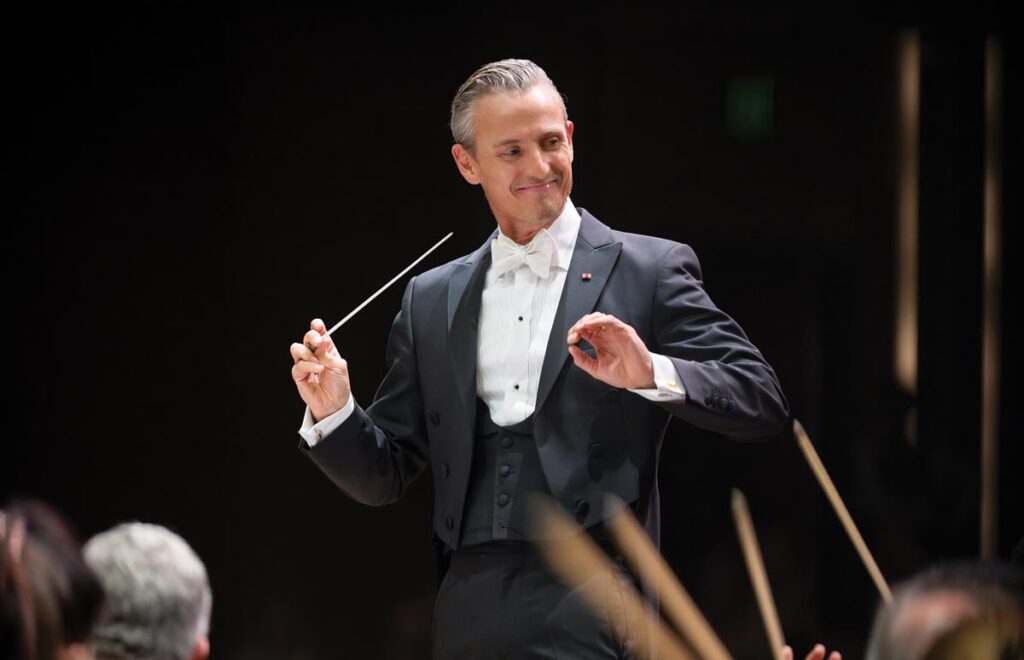
Early in his career, Shelley traveled worldwide serving as a guest conductor in a role he describes as the figurehead for a performance. His main task was building rapport with a variety of personalities and directing them. “An orchestra is an amazing, alert, and alive human ecosystem,” he says. “There is a total of usually about 80 people who started playing an instrument when only in their single digits and who have over 10,000 hours of practice in. All are experts in their field.”
Shelley likens a concert to a novel. The musicians and their instruments are in continual communication with one another, just as a book’s characters are. The conductor, like the author, leads the ensemble through the chapters, exploring a wide range of emotions and moods—from loss and desolation to solace, redemption, and love—in a shared time and space. Shelley determines how he will unlock the allegory of life, serving as a conduit between the musicians and the audience.

Before every performance, Shelley speaks from the stage to share some history about the piece and why he chose it. He then takes audiences and musicians on a journey, exploring even subtle nuances. He believes that whether in music or words, opening oneself to a great range and diversity of emotion promises an even more significant arrival. “The journey is the point,” he says.
In addition to appearing regularly across six continents with the world’s finest soloists and as a regular guest with renowned orchestras around the globe, Shelley fills several positions. He has served as principal associate conductor of London’s Royal Philharmonic Orchestra since 2015. This year marked his eleventh and final year as music director of Canada’s National Arts Centre Orchestra. After acting as the artistic and music director designate for the Pacific Symphony in Irvine, California, in 2025-26, he was named the artistic and music director for the upcoming season. He was also appointed principal conductor of the National Symphony Orchestra Ireland for 2026-27.

Keeping the Score
Shelley says his life today is full of variety. Home base is Surrey, England, where he lives with his wife, Zoe, a cellist and fitness trainer, and their two young sons, Sasha and Leo.
Although a busy man, much of his daily work is solitary—sitting at his desk planning performances and choosing pieces. He spends time studying how the music is constructed and imagining the score in his head. He communicates regularly with the key players of the various orchestras he works with and makes himself available for regular press interviews via Zoom, email, or phone.

His work involves 30 to 35 weeks of travel a year. “Jet lag is a constant,” he notes. Previously, he sought rest and recuperation when not on the road. Now, he focuses on spending as much time as possible with his family when home. He has learned to distill his work to the essentials while still giving the best of himself.

In 2024, Shelley began his official inaugural tenure at Artis—Naples. Kathleen van Bergen, Artis—Naples CEO and president for the past 15 years, was instrumental in bringing Shelley to this role. Having watched him grow and develop in his career and perform in Europe, she invited Shelley to Naples. His father often performed with the Naples Philharmonic in the 1990s, so Shelley was familiar with what he calls “the utopian beauty of the diverse and sophisticated coastal community.”
Ultimately, van Bergen outlines three reasons why he was hired. “His chemistry with the musicians was visceral, the response and the energy he created for the crowd was palpable, and he offered more than just a conductor role—bringing a rare expertise in all areas of the arts,” she says.
Artis—Naples is unusual in that it is one of few performing and visual arts centers under one roof, as was envisioned by late founder Myra Janco Daniels. Shelley, who realizes there is a different point of entry into the arts for everyone, understands this approach. “He helps tie everything together,” van Bergen remarks. “We needed a united artistic force, a collaborator for all artistic disciplines who thinks collectively for our organization,” she says.

As Shelley embarks on his third year in this role, he is occupied with establishing relationships and hiring new musicians as generational attrition occurs. Each year he crafts the season’s unifying theme. Shelley assists in planning exhibitions and commissioning impactful works, ensuring there is a common thread to all art forms, either on display or performed. He considers it a privilege to be working with the world-class cultural organization. “It is a great hub for creation; the sky is the limit,” he says.
This season’s theme is The Art of Hope, wherein Shelley seeks to answer what art is for. He suggests that “through image, music, movement, and story, art deepens our capacity for empathy, wonder, and shared understanding. It becomes a way to engage with our world more fully.” Ultimately, he asks what hope means. For Shelley, the answer to this question often comes at the finale of a performance he has led. “If heart and soul are lifted,” he says, then “I know I have purpose.” Bravo!
Story Credits:
Grooming: Nia for Duality Artistry





Facebook Comments